
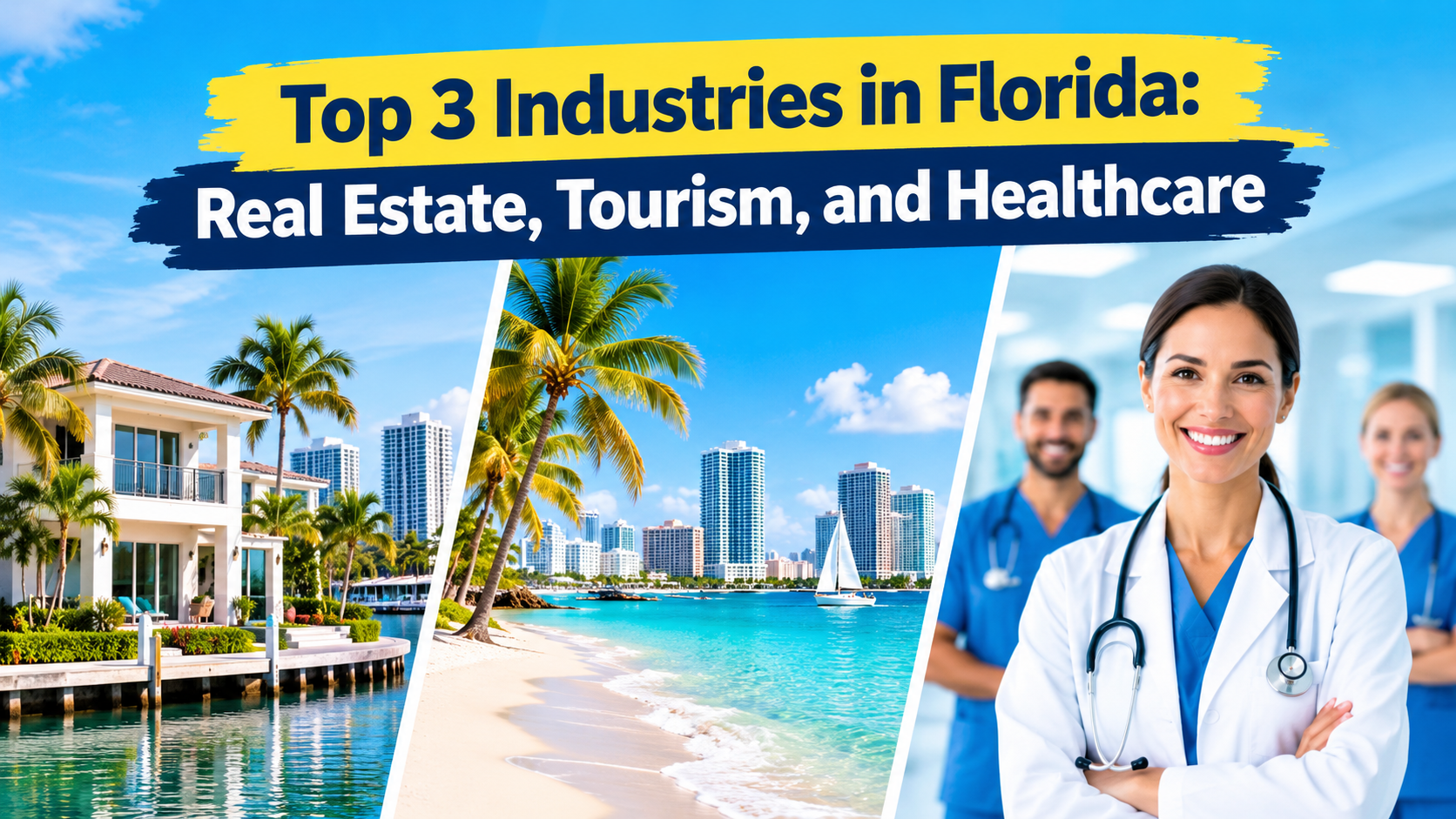
The top three industries in Florida are real estate, tourism and hospitality, and healthcare. Together they anchor a state economy with a GDP of about $1.73 trillion (2024), one of the largest of any U.S. state, and they shape where Floridians work, where capital flows and which cities grow fastest.
This guide explains how each industry earns its place, which regions and organizations lead it, and what business owners should watch next.
Rankings change depending on the metric. The U.S. Bureau of Economic Analysis (BEA) measures GDP contribution by NAICS sector. The Florida Department of Commerce tracks employment. Tourism does not exist as a single NAICS category, so agencies like VISIT FLORIDA measure it through visitor spending and economic impact instead.
For this article, “top industries” means the private-sector industries that combine the largest economic output, broad job creation and clear long-term demand. Government is a large employer and GDP contributor in every state, so it is treated separately from market industries.
| Industry | Metric | Figure | Year | Source |
|---|---|---|---|---|
| Florida economy | Nominal GDP | ~$1.726 trillion | 2024 | BEA |
| Real estate, rental and leasing | GDP contribution (inflation-adjusted) | ~$288.3 billion | 2025 | USAFacts / BEA |
| Tourism | Visitors | 143.3 million | 2025 | VISIT FLORIDA |
| Tourism | Economic impact | $133.6 billion | 2024 | VISIT FLORIDA |
| Tourism | Jobs supported | ~1.8 million | 2024 | VISIT FLORIDA |
| Healthcare (Southeast FL) | Direct jobs / GDP | 409,600 / $39.3 billion | n/a | Florida Council of 100 |
| Rank | Industry | Why it ranks |
|---|---|---|
| 1 | Real estate, rental and leasing | Largest GDP contributor of any sector |
| 2 | Tourism and hospitality | Record visitation and the biggest export-style revenue stream |
| 3 | Healthcare and social assistance | Largest and fastest-growing employment base tied to population aging |
Real estate, rental and leasing contributed the most to Florida’s GDP in 2025, at roughly $288.3 billion in inflation-adjusted terms according to USAFacts, drawing on BEA data. No other NAICS sector produces more output in the state.
Property insurance premiums, hurricane exposure, condominium reserve and inspection rules after the Surfside collapse, and affordability pressure on local workers are the main constraints on future growth. Property insurers and the Florida Office of Insurance Regulation sit at the center of that conversation.
Florida welcomed a record 143.3 million visitors in 2025, according to VISIT FLORIDA, the state’s destination marketing organization. About 91.5% of them were domestic travelers, roughly 131.1 million people. Overseas visitation reached 9.3 million, and Canadian travelers accounted for 2.9 million.
VISIT FLORIDA reports that tourism generated $133.6 billion in economic impact in 2024 and supported about 1.8 million jobs. It also estimates that visitor spending saves Florida households nearly $2,000 each in taxes.
Tourism spans lodging, restaurants, retail, transportation and entertainment, so official NAICS data splits it across several categories. Analysts at publications like Florida Trend note that “accommodation and food services” alone understates its reach in some ways and overstates it in others. That is why tourism is best read through visitor counts and economic impact studies rather than a single GDP line.
Hurricane season, softer Canadian visitation, labor shortages in hospitality and rising lodging costs all affect the sector.
Healthcare and social assistance consistently rank among Florida’s largest sectors by both GDP and jobs, and the state’s Department of Commerce and University of Florida’s Bureau of Economic and Business Research expect healthcare and education to lead job gains. In Southeast Florida alone, the Florida Council of 100 reports health services supporting roughly 409,600 direct jobs and $39.3 billion in GDP.
Nurse and physician shortages, Medicaid and Medicare reimbursement changes, and rising operating costs shape the next decade.
The top three do not tell the whole story. Several other sectors are large or strategically important:
| Metro | Leading industries | Notable anchors |
|---|---|---|
| Miami-Dade | Real estate, finance and international banking, tourism, trade | Brickell, PortMiami, Miami Beach |
| Orlando | Tourism, vacation rentals, hospitality-adjacent development | Walt Disney World, Universal Orlando (Epic Universe), Orlando Health |
| Tampa Bay | Healthcare, corporate relocation, fintech and cybersecurity, trade | Tampa General, Moffitt, Port Tampa Bay |
| Jacksonville | Logistics and industrial real estate, finance back-office, healthcare | JAXPORT, Mayo Clinic |
Florida’s three anchor industries create steady demand for the local businesses that serve them. These are the business categories that benefit most
| Anchor industry | Booming business types | Why demand holds | Strongest markets |
|---|---|---|---|
| Real estate | HVAC, plumbing, roofing, property management, inspections | New residents, aging housing stock, storm and insurance-driven repairs | Tampa Bay, Orlando, Jacksonville, South Florida |
| Tourism | Restaurants, short-term rental management, transportation, experiences | Record visitation and cruise traffic | Orlando, Miami, Florida Keys, Space Coast |
| Healthcare | Dental practices, home health, senior care, healthcare staffing | Large 65+ population and Medicare-funded demand | Statewide, especially Tampa Bay and Southeast Florida |
| Cross-sector | Auto repair, gas stations, pet services | Population growth and car-dependent commuting | Statewide |
Each leading industry creates a downstream market for local service businesses:
Businesses that align their services, location pages and content with these sectors can reach customers where Florida’s economic growth is concentrated.
Real estate, rental and leasing is the largest sector by GDP, contributing about $288.3 billion in 2025 (inflation-adjusted), according to USAFacts.
Tourism is Florida’s most recognized industry and a top economic driver, with 143.3 million visitors in 2025 and $133.6 billion in economic impact in 2024. By strict NAICS GDP measures, however, real estate ranks higher.
Recent state and chamber analyses list real estate, government, healthcare, professional and technical services, and retail trade as the largest sectors by output.
The Florida economy’s largest employment sectors include trade, transportation and utilities, government, professional and business services, education and health services, and leisure and hospitality.
Florida’s nominal GDP was about $1.726 trillion in 2024.
Healthcare, construction, technology and information services are among the sectors leading recent growth, though skilled-labor shortages and rising costs remain constraints.
Real estate, tourism and healthcare define Florida’s economy. Real estate produces the most output, tourism brings in record visitors and outside spending, and healthcare supplies the largest durable demand for workers. Understanding these three industries, and the regions and organizations behind them, helps investors, employers and local businesses plan where to compete in the Sunshine State.
Sources: BEA and USAFacts (Florida GDP by industry), VISIT FLORIDA (2025 visitation and 2024 economic impact), Florida Council of 100 (Southeast Florida industry data), Florida Chamber of Commerce (GDP composition), Florida Trend (industry rankings), Wikipedia “Economy of Florida.”