
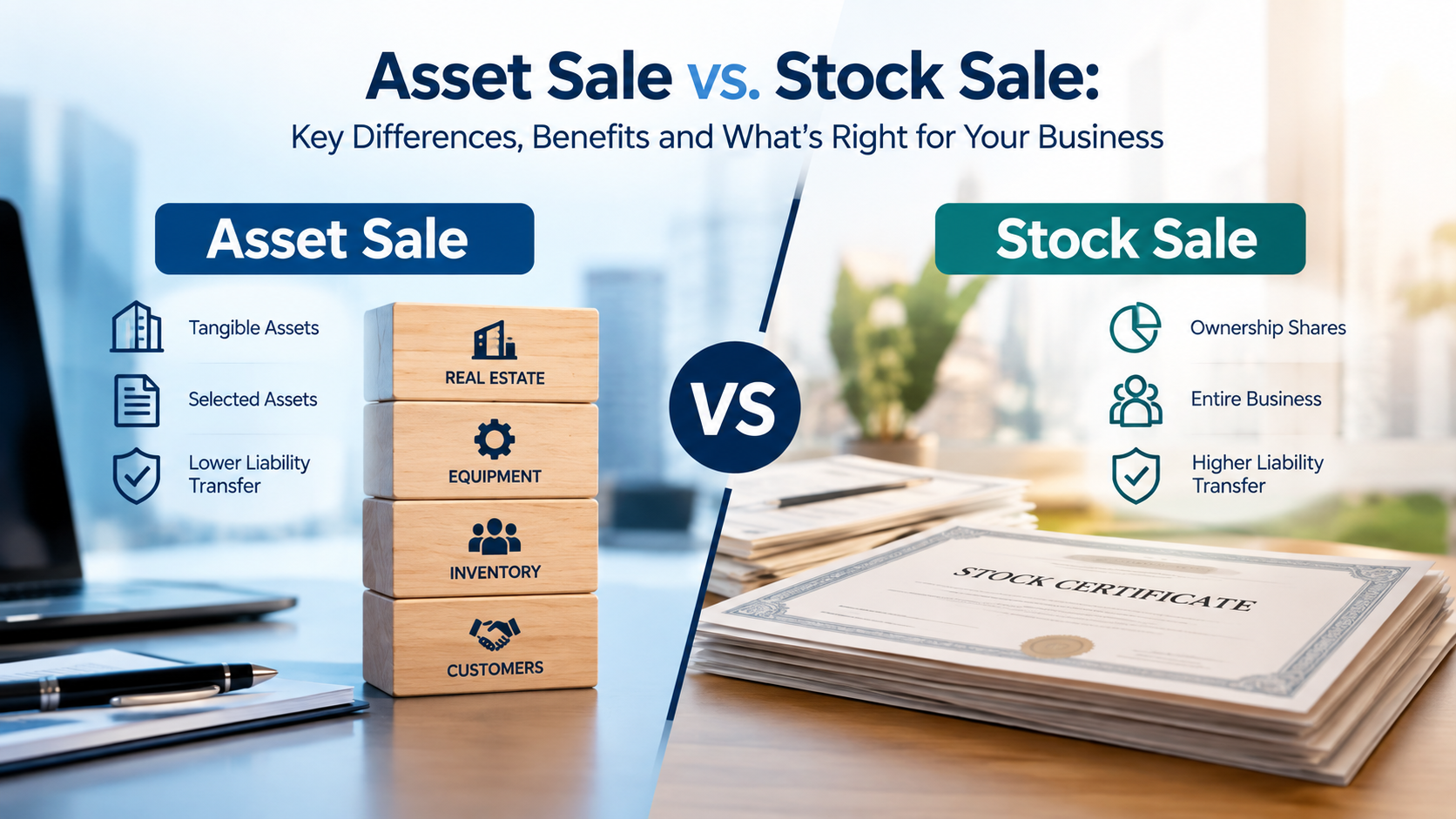
When a business changes hands in the United States, the deal closes as one of two legal structures: an asset sale or a stock sale (also called a share sale or equity sale). The label sounds like a technicality. It isn’t. The structure you choose determines who owns the tax liability, who inherits old lawsuits, how much of the purchase price the IRS takes, and how long the closing takes to negotiate.
Buyers and sellers almost always want opposite structures — and understanding why is the fastest way to protect your leverage at the negotiating table.
In an asset sale, the buyer purchases the individual assets and liabilities of the business — equipment, inventory, customer contracts, intellectual property, goodwill, leasehold interests — rather than the legal entity that owns them. The seller’s corporation or LLC continues to exist after closing; it simply no longer holds the operating business. The seller (not the buyer) keeps the entity, along with any liabilities the buyer didn’t explicitly assume.
Core entities involved in an asset sale:
Because assets are transferred individually, every material contract, lease, vendor agreement, and government license typically needs a consent to assign or a fresh application in the buyer’s name. This is the main reason asset deals take longer to close than stock deals.
In a stock sale, the buyer purchases the ownership shares (or membership units, in an LLC) directly from the shareholders. The legal entity — with its existing contracts, licenses, bank accounts, EIN, and liabilities — passes to the buyer intact. Nothing about the underlying business changes hands; only who owns the entity changes.
Core entities involved in a stock sale:
Because the entity itself is what’s being sold, third-party contracts and licenses generally stay in place without requiring reassignment — unless those contracts contain a change-of-control clause that triggers renegotiation or termination rights.
| Factor | Asset Sale | Stock Sale |
|---|---|---|
| What’s transferred | Individual assets and select liabilities | Ownership shares/units of the entity |
| Who keeps the legal entity | Seller | Buyer |
| Liability exposure for buyer | Limited to what’s contractually assumed | Full historical liability, known and unknown |
| Contract/license reassignment | Usually required | Usually not required (absent change-of-control clauses) |
| Buyer’s tax basis | Stepped up to fair market value | Carries over from seller (no step-up, absent election) |
| Seller’s tax treatment | Often double taxation risk if a C-corp | Single layer of capital gains tax |
| Closing complexity | Higher (asset-by-asset transfer) | Lower (single entity transfer) |
| Typical buyer preference | Preferred | Avoided unless discounted |
| Typical seller preference | Avoided unless premium paid | Preferred |
Buyers gravitate toward asset deals for two structural reasons: liability containment and tax basis step-up.
An asset purchase lets the buyer cherry-pick which liabilities to assume. Old lawsuits, unpaid vendor invoices, pending tax audits, employee claims, and environmental exposure generally stay with the seller’s entity. This is the single biggest reason private equity buyers, strategic acquirers, and first-time buyers of small businesses push for asset structures — it insulates the buyer’s other assets from the target’s legal history.
There’s an important caveat: successor liability. Under certain state laws and federal statutes (notably in areas like employment, environmental contamination, and product liability), courts can hold an asset buyer responsible for a seller’s obligations even without an explicit assumption clause — particularly if the deal looks like a “mere continuation” of the old business. Buyers mitigate this with thorough due diligence, indemnification escrows, and representations and warranties insurance.
In an asset sale, the buyer gets to record the purchased assets at their new, higher fair market value. This creates a larger depreciation and amortization base going forward, which reduces the buyer’s taxable income for years after closing. That step-up is one of the most valuable — and most fought-over — mechanics in the entire transaction.
For a seller operating as a C-corporation, an asset sale can trigger double taxation: the corporation pays tax on the gain from selling its assets, and then the shareholders pay tax again when the remaining proceeds are distributed to them. A stock sale avoids this entirely — shareholders sell their shares directly and pay capital gains tax once, typically at preferential long-term rates if held more than a year.
S-corporations, partnerships, and LLCs taxed as pass-throughs don’t face the same double-tax exposure in an asset sale, which is part of why so many lower-middle-market deals (where pass-through entities are common) end up structured as asset sales despite the seller’s general preference for stock deals.
Selling stock transfers the entity — and everything wrapped inside it — to the buyer. Once the deal closes, the seller has no ongoing exposure to the operating liabilities of the business (subject to the indemnification terms negotiated in the purchase agreement). This is attractive to sellers who want a genuinely clean break, particularly owners retiring out of the business entirely.
Because contracts, licenses, and permits stay with the entity, there’s no need to individually reassign leases, vendor agreements, or state licenses. For businesses with dozens of active contracts — franchises, medical practices, government contractors — this can shave weeks off the closing timeline.
Buyers want the tax basis step-up. Sellers want the legal simplicity and single tax layer of a stock sale. The Section 338(h)(10) election exists to reconcile the two, at least in specific circumstances.
Available when the target is an S-corporation or a subsidiary of a consolidated corporate group, this joint election allows the parties to structure the transaction legally as a stock sale — shares change hands, contracts stay intact, no bulk-sale notices — while the IRS treats it as if it were an asset sale for tax purposes. The buyer gets the stepped-up basis; the seller keeps the operational simplicity of a stock deal.
A related mechanism, Section 336(e), achieves a similar result in certain transactions that don’t qualify for 338(h)(10), including some S-corp sales to non-corporate buyers.
These elections require careful modeling — the seller’s tax bill can actually increase under a 338(h)(10) election depending on the entity’s asset mix, so it’s negotiated (and often priced into the purchase agreement) rather than assumed.
In any asset sale, the buyer and seller must jointly allocate the total purchase price across specific asset classes — cash, inventory, equipment, intangibles, and goodwill — using IRS Form 8594 under Section 1060. This allocation has opposing incentives baked in:
This allocation isn’t just paperwork — it’s frequently one of the last negotiated line items before signing, because it directly shifts real after-tax dollars between buyer and seller.
The final structure is rarely dictated by one party — it’s negotiated, and the purchase price itself usually adjusts to reflect which structure is chosen. A buyer willing to accept a stock sale (and its liability exposure) will typically demand a lower price, stronger representations and warranties, a larger indemnification escrow, or a representations and warranties insurance (RWI) policy to offset the risk. A seller willing to accept an asset sale (and its potential double taxation) will typically negotiate a higher headline price to offset the tax hit.
For lower-middle-market and Main Street business sales — the deals most business brokers handle day to day — asset sales are the more common outcome by a wide margin, largely because buyers of smaller businesses are far less willing to absorb unknown legal exposure than institutional acquirers with larger indemnification programs.
A stock sale is usually better for a seller because it typically results in a single layer of capital gains tax and a cleaner exit from future liability. However, if the buyer will only pay a premium price for an asset deal, or if the entity carries risk the seller wants to shed, an asset sale can still be the stronger economic outcome.
An asset sale is usually better for a buyer because it limits inherited liability to what’s explicitly assumed and provides a stepped-up tax basis on the purchased assets, which increases future depreciation deductions.
No. In an asset sale, the seller’s entity technically terminates the employees, and the buyer must formally rehire them, which can trigger WARN Act notice obligations and payout of accrued benefits. In a stock sale, employment continues without interruption because the employer entity doesn’t change.
Contracts and leases generally must be individually assigned to the buyer, which often requires the third party’s written consent. This is one of the main reasons asset sales take longer to close than stock sales.
It’s a joint IRS election available for S-corporations and certain subsidiary sales that lets a legal stock sale be taxed as an asset sale. The buyer gets the depreciation benefits of a stepped-up basis, and the seller retains the simpler mechanics of a stock transaction.
Not entirely. Courts can apply successor liability doctrines — especially in employment, environmental, and product liability contexts — if the buyer’s business looks like a continuation of the seller’s. Thorough due diligence, indemnification provisions, and reps and warranties insurance are used to manage this residual risk.
Buyers of Main Street and lower-middle-market businesses typically lack the institutional indemnification infrastructure of larger acquirers, so they’re far less willing to absorb unknown legal or tax liability. Combined with the tax basis step-up benefit, this pushes most small business transactions toward an asset sale structure by default.
Yes, and it usually does. Because each structure shifts tax burden and liability risk between the parties, the negotiated price is typically adjusted to compensate whichever party is taking on more risk or tax exposure under the chosen structure.
It’s the IRS-required breakdown (via Form 8594 under Section 1060) of how the total purchase price is assigned across asset categories like equipment, inventory, and goodwill. Because different categories are taxed differently, buyers and sellers often have opposing preferences on how the allocation is structured, making it a frequently negotiated deal term.
Generally yes, because the legal entity holding the license doesn’t change ownership at the entity level. This is a key reason regulated businesses — like those holding liquor licenses or healthcare facility licenses — often favor stock sale structures despite the added liability exposure to the buyer.